The Right Wing That Won't Build Europe
Europe's mainstream right is chasing the far right on immigration and calling it a European project. It is not. And the difference is everything.
Mainstream conservatives are passing EU regulations and calling it integration. But coordinating is not integrating. And time is running out.
There is a comfortable story circulating in pro-European circles at the moment. It runs as follows: the pressure exerted by the far right is forcing mainstream parties to adopt its positions, and this shift is producing, somewhat paradoxically, more European cooperation. Governments are coordinating on borders, constructing common immigration policies, passing legislation that would have seemed unthinkable a few years ago. Integration, in other words, is advancing, albeit in a rather different form from the one the federalists had in mind.
I should like to explain why this story is mistaken. And why the rightward drift of Europe's political centre of gravity will not produce more Europe. It will produce less.
The rightward chase that isn't working
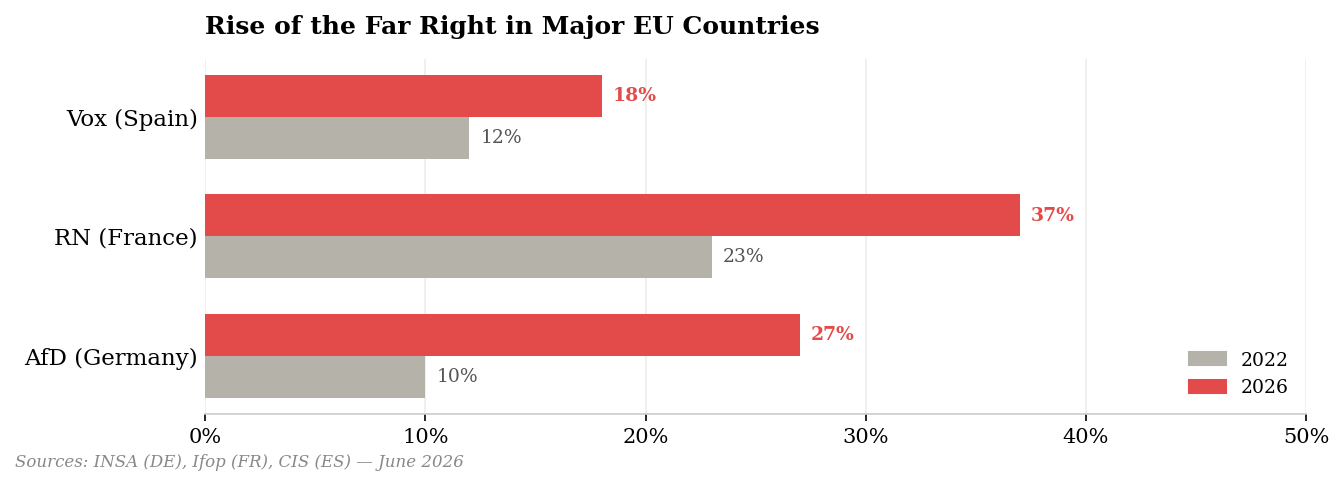
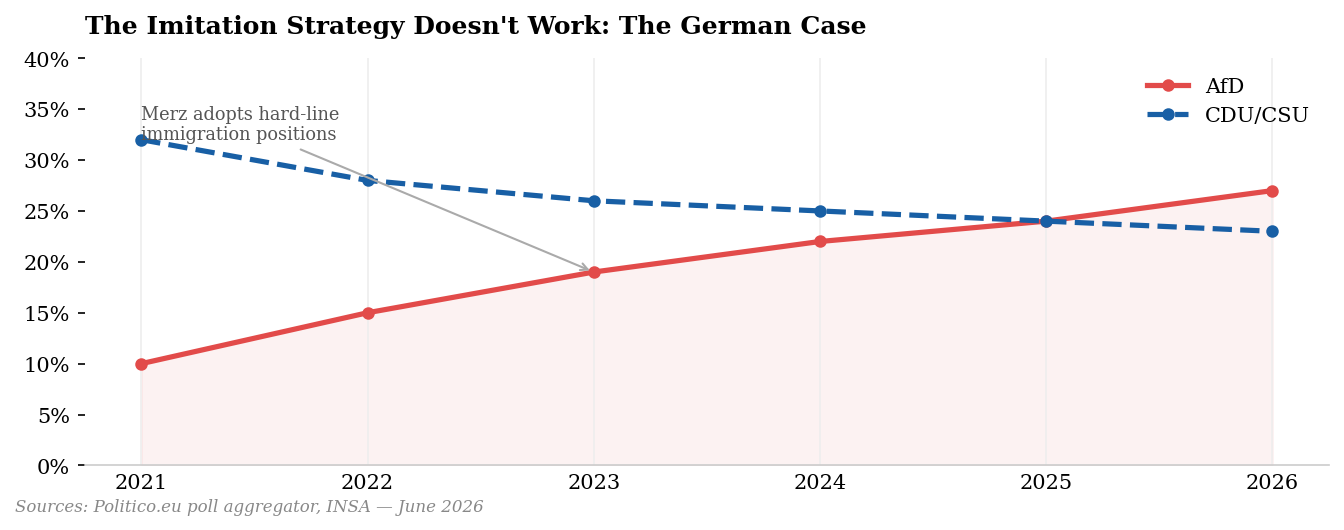
In every major European country, far-right parties have grown substantially. In Germany, AfD has risen from 10% in 2022 to 27% today, making it the leading party in the polls. In France, the Rassemblement National commands a comfortable margin. The structural paradox is rather glaring: wherever mainstream conservatives have adopted the far right's positions on immigration, the far right has continued to grow regardless. In Germany, Friedrich Merz introduced immigration measures harder than those of any previous chancellor. AfD remains number one.
The mechanism is not especially complicated. The voter who supports AfD or the RN is not primarily seeking tougher policies. They are seeking an identity, an oppositional posture towards a system they distrust. When the mainstream right adopts those same policies, it does not win those voters over. It vindicates them. It tells them they were right all along. And they continue to vote for the original, not the imitation.
Data from the European Council on Foreign Relations makes the point rather starkly: 66% of Law and Justice supporters, 57% of AfD supporters, and 53% of Vox supporters believe their mainstream opponents privately wish to open their country's borders. In such an environment, no policy platform can establish credibility, as it has already been dismissed as a facade.
The difference between cooperation and integration
The returns regulation passed yesterday in Strasbourg is an act of intergovernmental cooperation. It is politically significant. But it is not integration in the sense intended by Spinelli, Monnet, and De Gasperi. Nor in the sense that Jürgen Habermas theorised with his concept of European constitutional patriotism, a political community founded on shared values rather than ethnic or national identity. Nor in the sense in which Larry Siedentop, in Democracy in Europe, located the true obstacle to integration: not an absence of popular will, but the resistance of national elites to relinquishing power. Genuine integration means ceding sovereignty to a centre: a common budget with autonomous fiscal capacity, a foreign policy conducted by a minister who speaks for all member states, a unified defence command.
The parties that won yesterday's vote cooperate when it suits them. They will not cede meaningful competencies to Brussels on taxation, defence, or foreign policy. The return centres in third countries will be administered by individual governments, not by a European agency with an independent mandate. That is coordination. It is not integration.
Citizens want more Europe. Their governments do not.
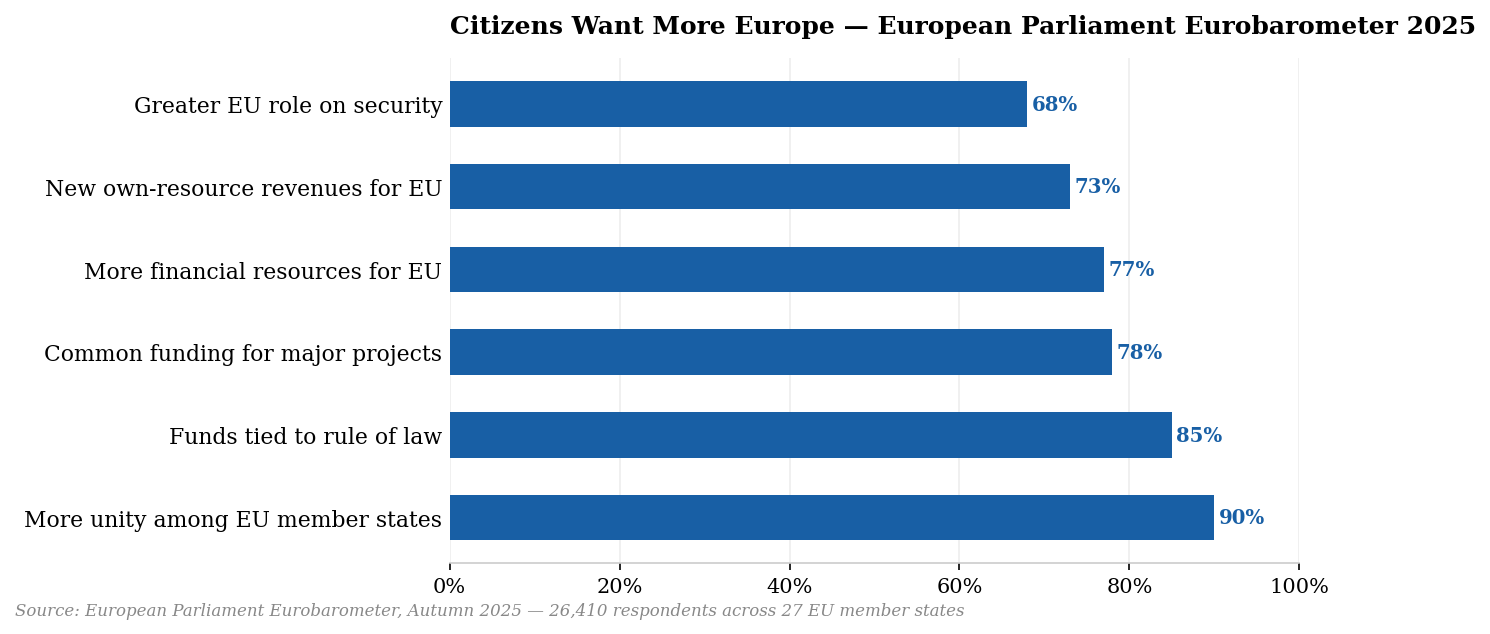
Here one encounters the deepest fault line. Ninety per cent of European citizens believe member states should be more united in confronting global challenges. Seventy-eight per cent think an increasing number of projects will require common funding. Seventy-three per cent support the introduction of new own-resource revenues for the EU. These are rather remarkable figures. They suggest that European citizens are considerably further ahead of their governments on the question of integration.
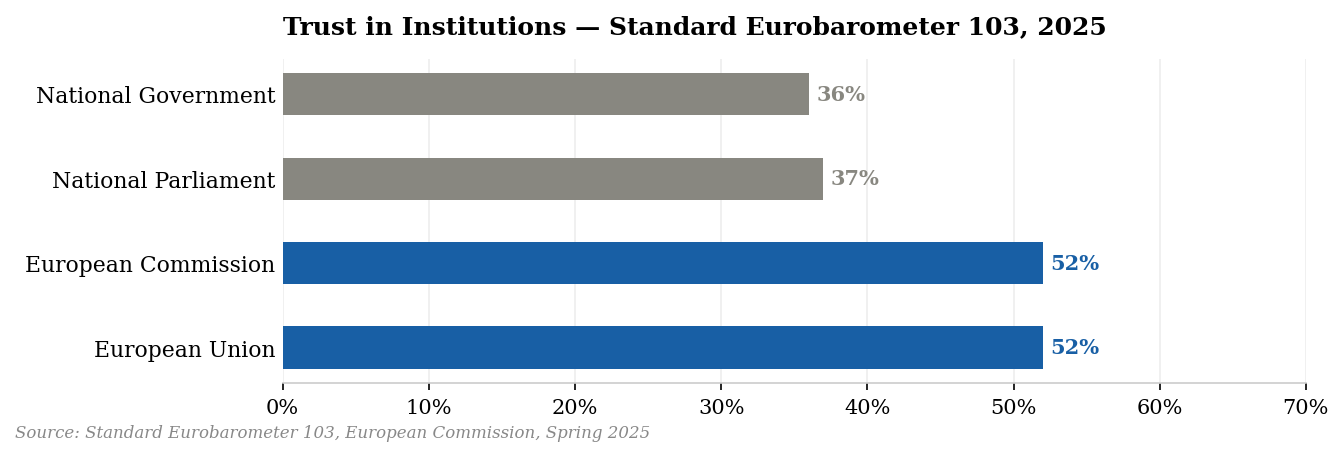
There is more. Only 36% of Europeans trust their national government, and 37% trust their national parliament, compared with 52% who trust the European Union. Citizens trust Brussels more than they trust their own capitals. And yet the governments that control the European Council are predominantly led by forces that regard national sovereignty as beyond negotiation.
The Draghi and Letta reports: dead letters or final warnings?
In September 2024, Mario Draghi presented a report estimating the EU's additional annual investment requirements at between 750 and 800 billion euros, equivalent to 5% of GDP, a figure exceeding even the Marshall Plan's 1 to 2%. To finance this, Draghi stated explicitly that the issuance of common, supranational debt would be necessary. Enrico Letta, for his part, had warned that implementing his own report's recommendations represented the last window of opportunity to end the EU's fragmentation.
That window has not been opened. The Draghi report has remained largely unimplemented. Little or nothing has been done on reducing energy costs, pooling resources to support European businesses, investing in artificial intelligence, or constructing a genuine capital markets union. The European Commission's own 2026 Single Market Report concedes that what was once the engine of integration has been slowed by national obstacles and internal barriers.
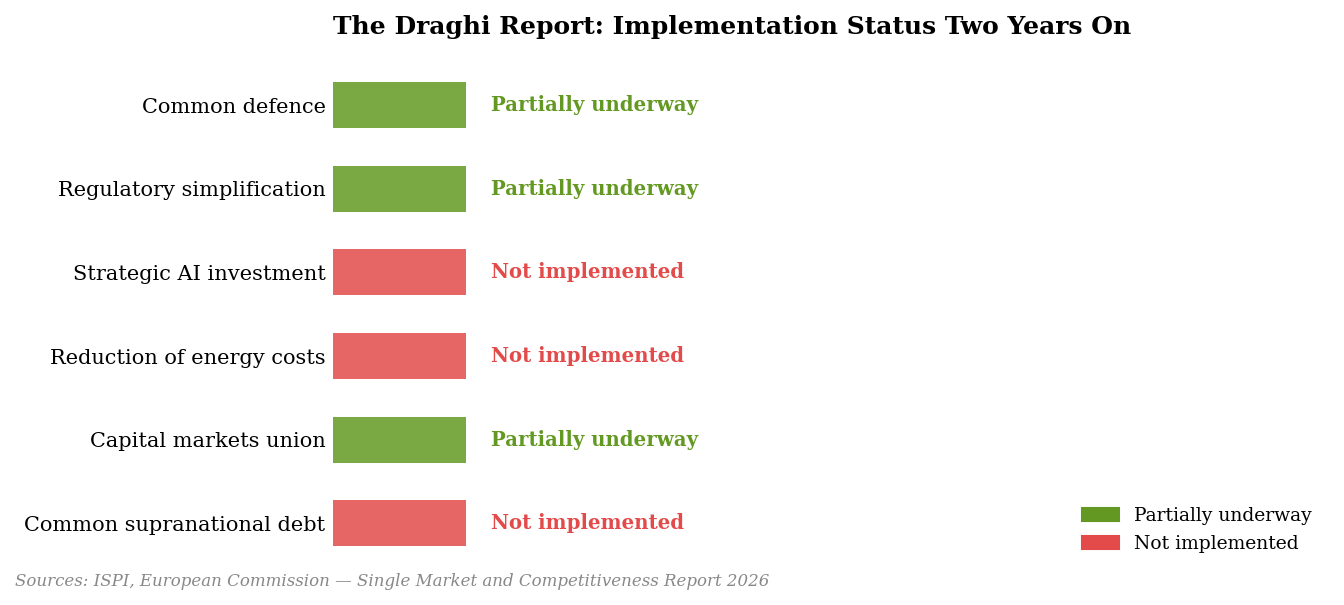
Both reports are, in effect, dead letters on the matters that count: fiscal integration, common debt, supranational industrial policy. They survive in attenuated form only where they confine themselves to intergovernmental coordination.
Why support for Europe does not translate into votes
Here is the harder question. If the majority of Europeans favour greater integration, why do the nationalists keep winning? The answer has five components, and none of them is especially flattering.
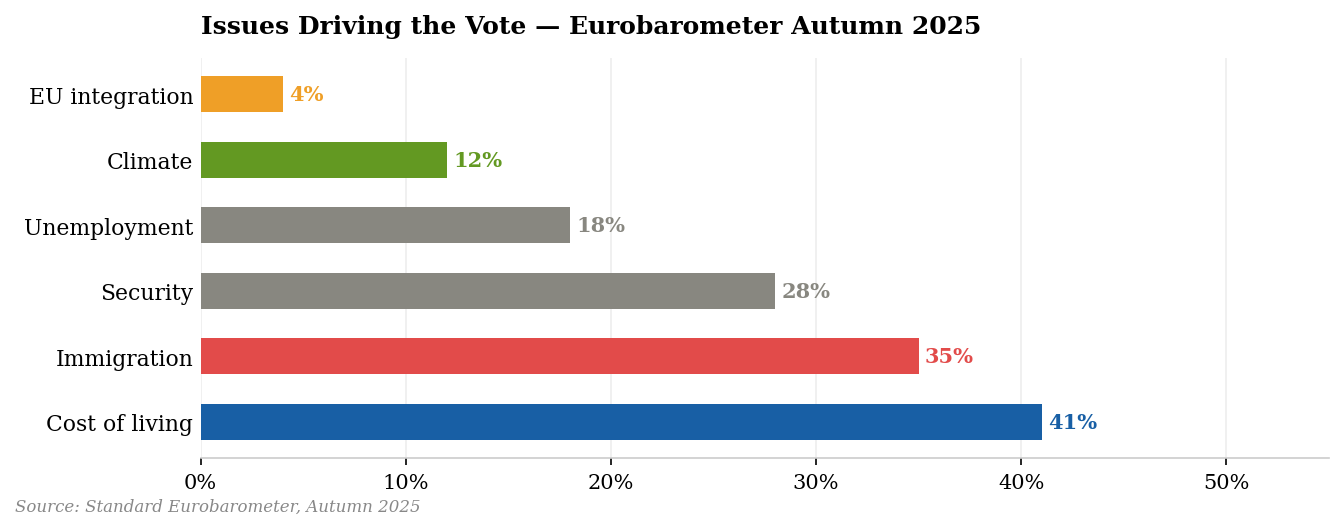
The first concerns the actual weight that issues carry at the ballot box. European citizens may want more Europe, but this preference is not sufficiently urgent to determine how they vote. European federalism is something people support in the abstract, not something for which they march or change their political allegiance. According to the Eurobarometer of autumn 2025, the issues that drive voting behaviour are the cost of living for 41% of respondents, immigration for 35%, and security for 28%. European integration as a direct electoral priority registers below 5%. The right wins because it commands the issues that frighten people. The European project does not frighten anyone, and therefore does not move votes.
The second concerns the architecture of European elections. No genuinely European political space exists. European elections are, in practice, 27 separate second-order national contests in which voters punish incumbent governments and reward the noisiest opposition. This structure systematically advantages the far right, which is almost invariably in opposition.
The third is a matter of lost credibility. The parties that have historically governed Europe are associated in the popular imagination with the crises of the past two decades: the austerity of 2010 to 2015, the chaotic management of migration in 2015, the pandemic, inflation. When they propose more Europe, the voter's instinctive response is: more Europe like the one I have already experienced?
The fourth is the absence of an identity narrative. The right has grasped something that the left and the liberals persistently refuse to acknowledge: modern politics is won on identity, not on platforms. The argument that Europe makes us more competitive against China and the United States is rationally sound but emotionally inert. "Our borders, our people, our future" is rationally crude but emotionally potent.
The fifth is structural. The political forces that currently dominate the European Council derive their legitimacy from the existence of nation-states as sovereign political units. A federal Europe, with a common government, budget, and foreign policy, would deprive Meloni, Le Pen, and their allies of their very raison d'être. They are structurally incentivised not to build it.
A pan-European movement is needed. Building one is considerably harder than it sounds.
If the majority of European citizens favour greater integration, the logical question is this: why has no genuinely pan-European political movement emerged, one with coordinated leadership across multiple nations and a common programme for integration? The question is reasonable. And attempts have been made.
The Party of European Socialists has existed since 1992, the EPP rather longer. But these are federations of national parties, not genuinely European ones. Every national secretary campaigns on national issues, with national symbols, before national electorates. The European label is a footnote on the campaign literature. The most serious attempt to construct something genuinely transnational has been Volt Europa, founded in 2018, with the same programme and the same candidates across all member states. It holds seats in several national parliaments and in the European Parliament. But it remains a niche party, with a predominantly young and urban base.
The principal obstacle is legal and structural. European parties may not campaign in member states using European funds. They may not stand their own lists in national elections, which are precisely the elections that determine political weight in the Council. The system is constructed, whether by design or by inertia, to prevent genuinely European politics from taking root.
The second problem is one of language, understood in its broadest sense. A pan-European movement requires leaders capable of addressing all Europeans simultaneously. No European media space exists: no television channel, no newspaper, no platform that aggregates a continental public opinion. Without a European demos, European politics cannot emerge.
The third problem is what the political scientist Peter Mair termed the void: traditional parties have drifted away from civil society and become administrative apparatuses. A new European party would need to establish social roots in twenty countries simultaneously, with limited resources and without access to dominant national media.
And yet the moment may be more propitious than it appears. Existential threat is the new element, one that did not exist ten years ago. Technological dependence on the United States, American disengagement from European defence, Chinese competition, climate change: these are challenges that no European state can address in isolation, and citizens are increasingly aware of this. This is precisely the sort of fear that can forge a common political identity. Not fear of foreigners, which divides. Fear of irrelevance, which might unite.
Draghi has said as much. Siedentop anticipated it. Habermas has been arguing the point for thirty years. The difficulty is that no one has yet translated that analysis into concrete political organisation. Until someone does, popular will for more Europe will continue to dissipate across twenty national electoral systems, without a political vehicle capable of carrying it forward.
What is missing
To channel the popular will for greater integration towards political forces genuinely committed to pursuing it, three things are required, and all three are presently absent. A genuinely European public space, with transnational media and debate capable of creating a European demos that transcends national boundaries. Parties that compete on a truly European scale, with continental candidates, programmes, and campaigns. And a pro-European identity narrative that harnesses the right kind of fear: not fear of outsiders, but fear of geopolitical irrelevance, of technological dependency, of a continent that ceases to matter.
Draghi put it with characteristic precision: either we change radically, or it will be a slow agony. That is an emotionally powerful argument. The difficulty is that no party has made it their existential cause. They have read it as a technical report. And technical reports do not win elections.
European federalism did not die because of the right. It died because no one had the courage to defend it as one defends something one genuinely cares about. The right is simply sitting on the grave and declaring victory.