The Sun Isn't Enough
Solar produced a quarter of Europe's electricity in June, a historic record. But behind the aggregate figure lie an Italy left behind, national grids that don't talk to each other, and a renewables race that was also born as a weapon against Russian energy blackmail.
A quarter of Europe's electricity now comes from solar, a historic record
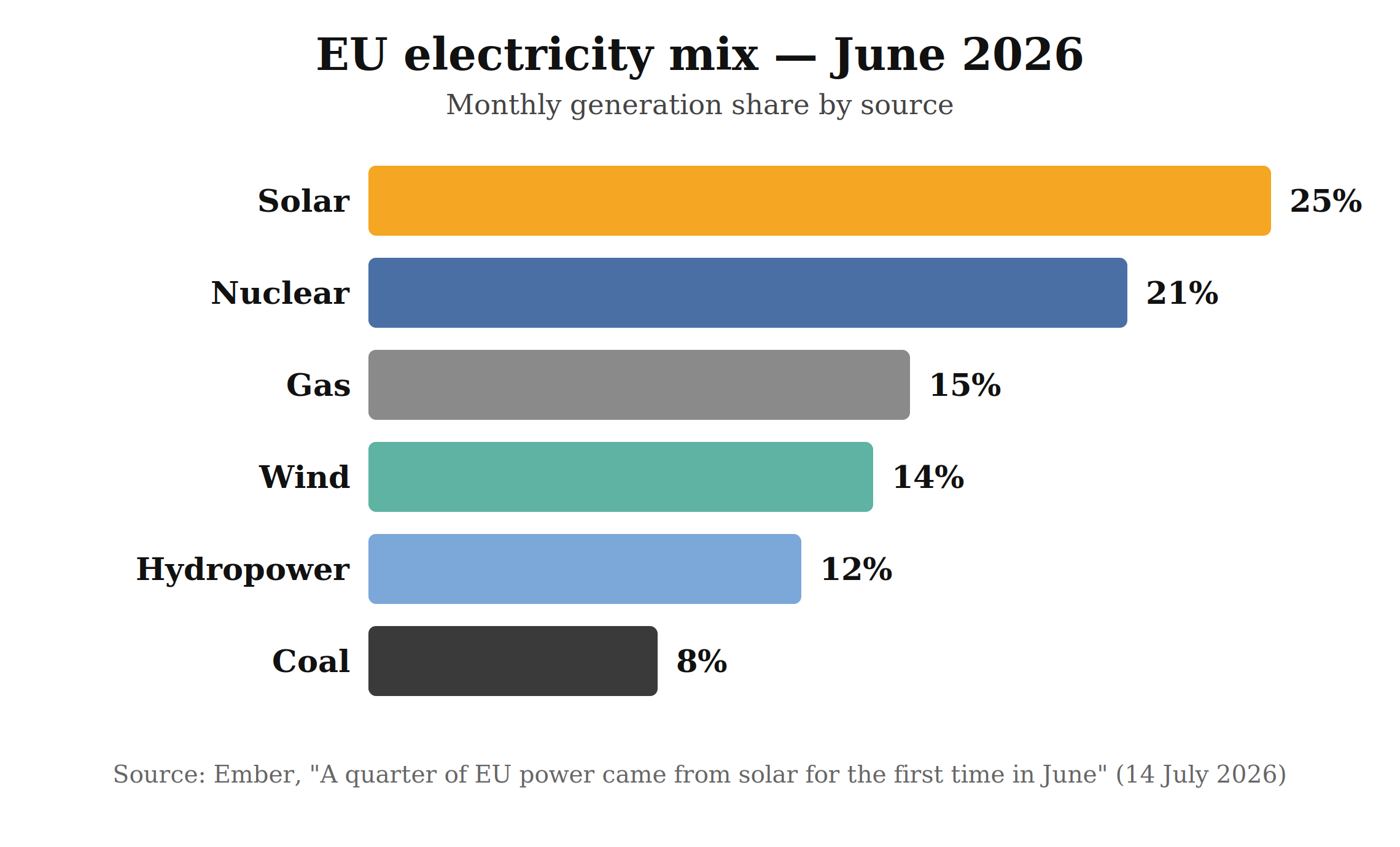
A quarter of Europe's electricity produced by the sun. A figure that would have sounded like science fiction just five years ago, and yet in June 2026 became reality: 52 TWh, 25% of the bloc's monthly generation, ahead of nuclear (21%), gas (15%), wind (14%) and coal, down to a residual 8%. These are numbers that describe an extraordinary trajectory, over 20% annual growth since 2021, and they deserve to be celebrated for what they are: proof that Europe's energy transition, against the odds, is actually happening.
But an aggregate figure is also an elegant way of hiding some contradictions. Eighteen of the twenty-seven member states set new monthly solar records this year, a sign of just how widespread the phenomenon has become, rather than a German or Iberian exception. Available sources do not name all eighteen countries, but the three examples that come up most often are enough to convey the scale of the shift.
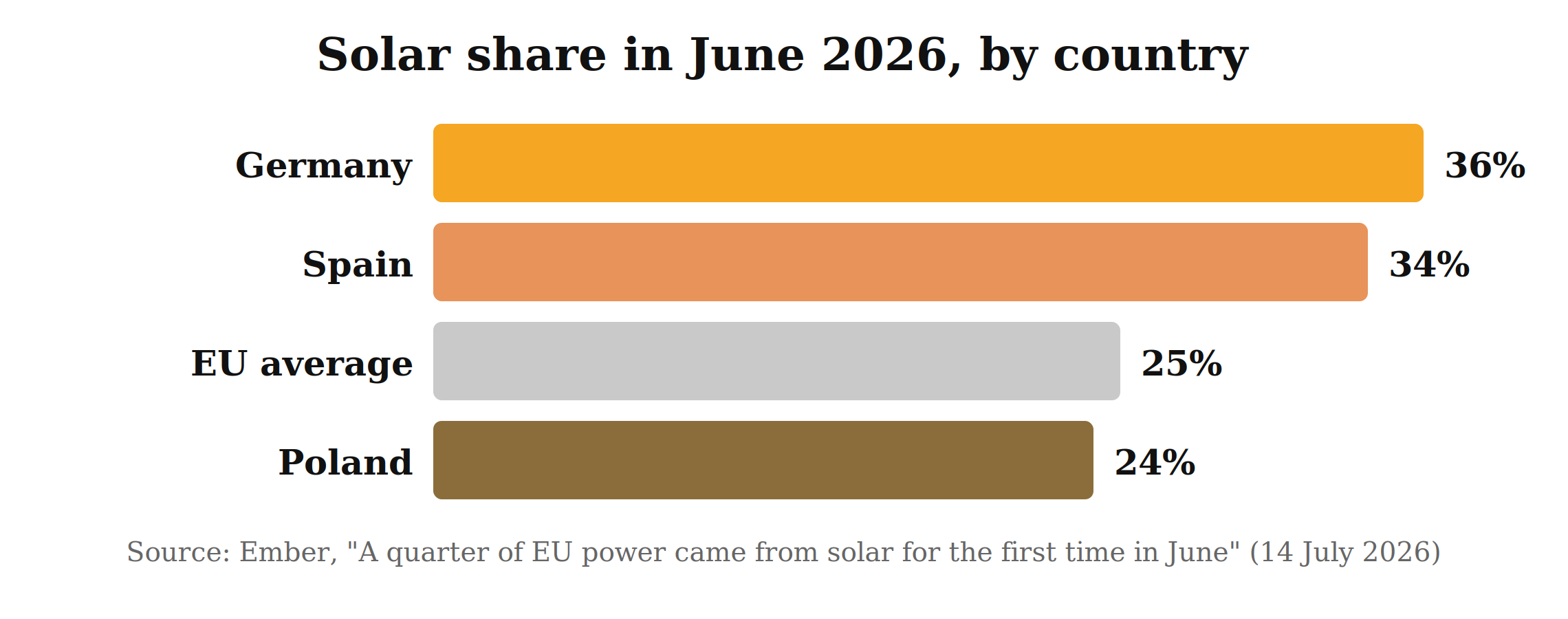
Germany reached 36% of its electricity from solar in June, up from 33% in May. Berlin, which spent a decade debating whether and how to exit nuclear power and reduce its dependence on Russian gas, has found in solar an answer that no one, not even the most optimistic champions of the Energiewende, expected this quickly. Spain follows closely behind on 34%, its first month above the psychological threshold of a third. Madrid bet early and decisively on renewables, and is now reaping the rewards, even if it paid the price for the flip side of that bet in April, more on which shortly. Poland, paradoxically, is doing better than one might expect: 24%, roughly in line with the continental average, despite remaining one of Europe's biggest coal consumers, simply because it has installed over 20 GW of solar capacity in five years.
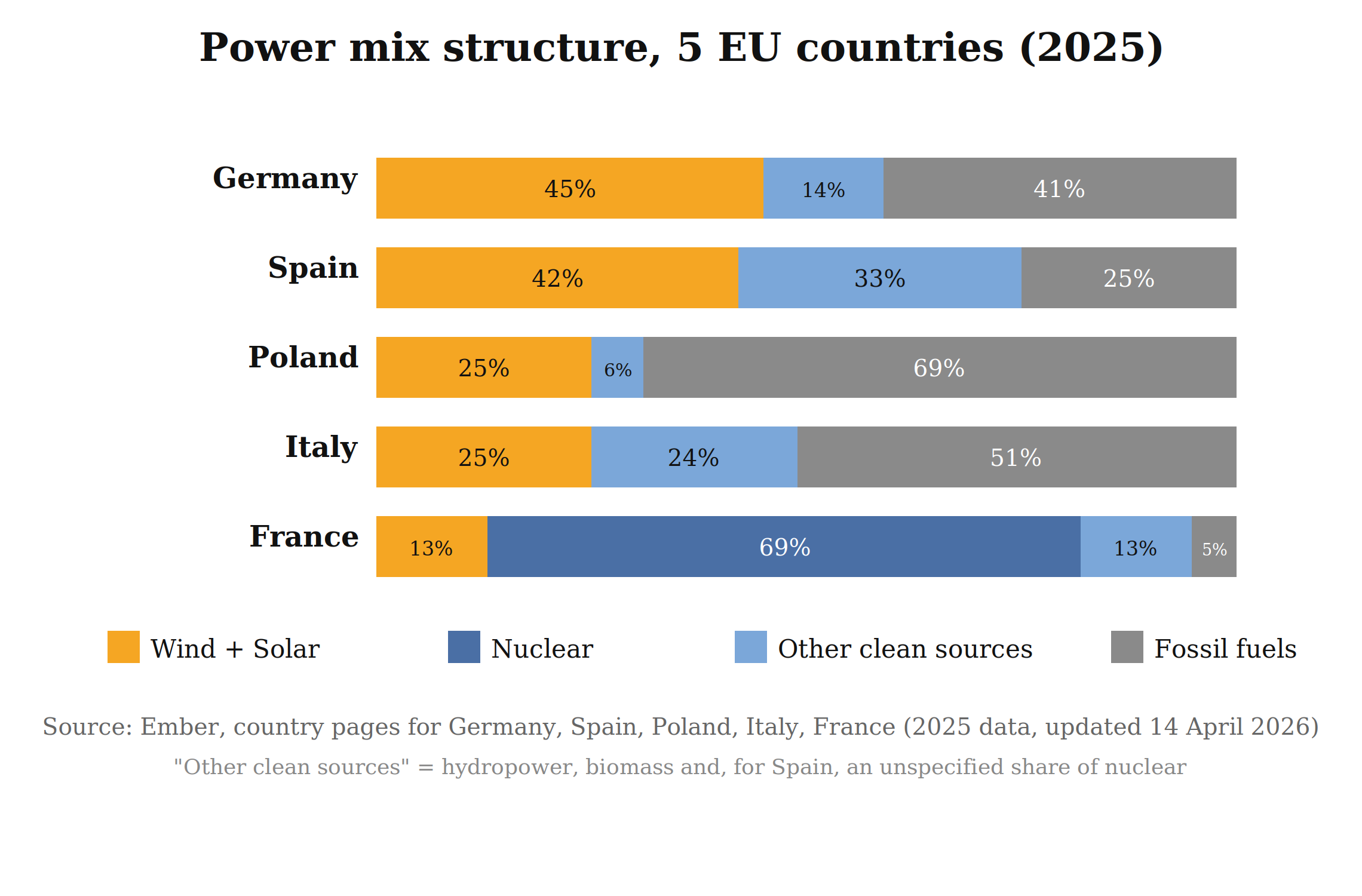
If we look instead at the underlying structure of national energy mixes, rather than at this month's records, the picture widens and grows slightly more complicated. Italy, which enjoys some of the best solar irradiation in Europe, remains strikingly behind: 17% from solar, a mere 8% from wind, fossil fuels still accounting for 51% of the mix against an EU average already below 30%. Italy's problem isn't a shortage of sunshine, it's a problem of political choices, permitting, grid capacity, an industrial energy policy that has never truly decided what it wants to be. If Warsaw can manage it, one has to wonder what Rome is waiting for. Then there are France and Slovakia, where nuclear remains the backbone of the power system, over 65% of output. That isn't a lack of foresight, it's a bet placed decades ago that, in a continent rediscovering the value of energy security, now looks, in all honesty, rather well judged. Paris isn't chasing solar with the same urgency as others because it simply doesn't have the same structural need.
The grid problem, not the production problem
At this point, Europe's real challenge is no longer so much how much clean energy it produces, but how little its national grids talk to each other. April's Iberian blackout demonstrated this in the starkest possible terms: Spain, with a surplus of solar output it couldn't offload elsewhere, watched its system collapse. Not a problem of scarcity, but of poorly distributed excess. It is the perfect snapshot of a continent that produces common policies, directives, 2030 targets, yet remains fragmented in the physical infrastructure that ought to make them actually work, in exactly the same way as on defence and on developing the new steam engine of our age: AI.
This is also, not coincidentally, one of the central issues in the Draghi report on European competitiveness. There's no serious way to talk about industrial productivity, reindustrialisation, or competing with the United States and China, if energy costs remain structurally higher in Europe than elsewhere, and if, above all, cheap energy produced in one corner of the continent cannot reach those who need it elsewhere. An extra solar panel in Andalusia does little for Bavarian manufacturing if there's no electric motorway between the two points capable of carrying it there.
The real stakes: leverage
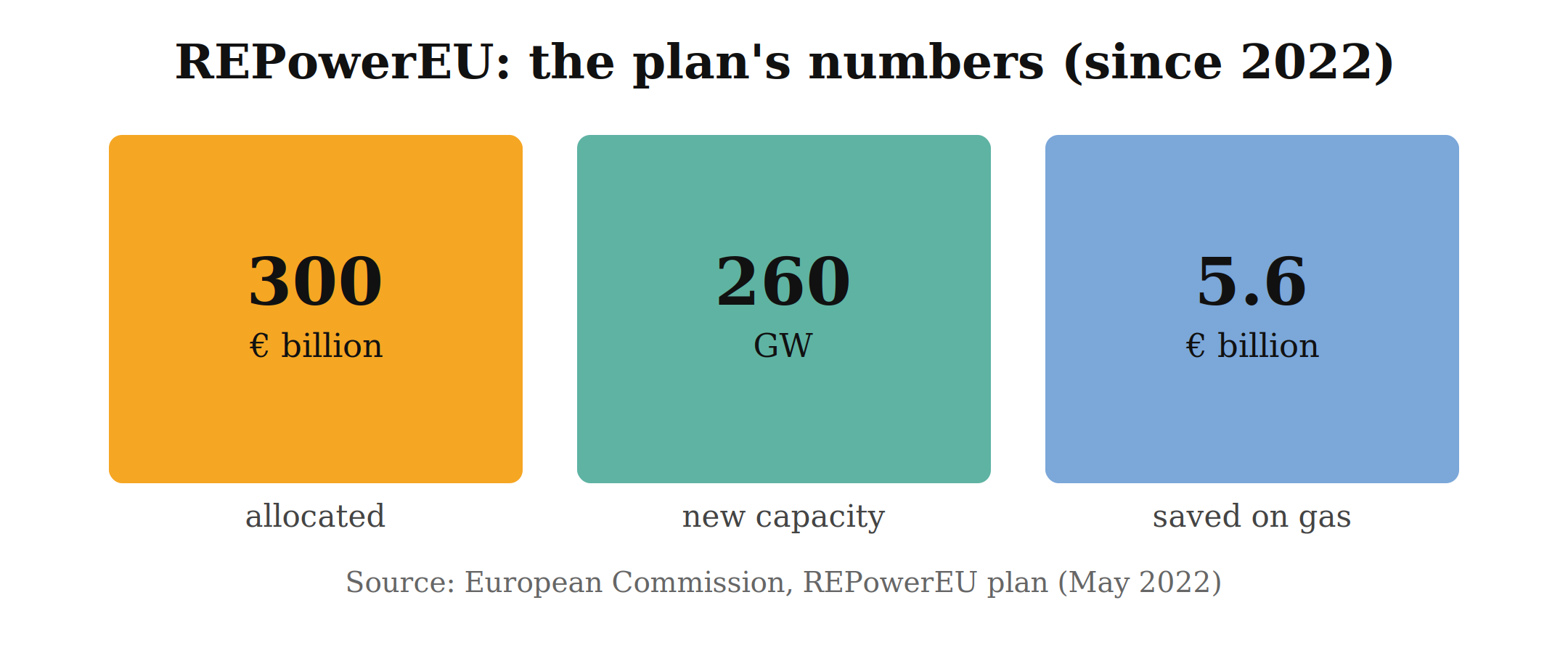
And this is where the energy conversation stops being merely technical and economic, and becomes distinctly geopolitical. This renewables race didn't happen by accident, nor purely out of environmental virtue: it has a precise origin, and it is as political as it is energy-driven. Brussels put real money behind it, and did so above all from one clear moment of rupture. The Green Deal of December 2019 had set the strategic framework, but it was with REPowerEU, launched in May 2022 as a direct response to Russia's invasion of Ukraine, that the Union truly opened its purse strings: roughly €300 billion in total, between loans and direct grants, with 40% earmarked specifically for affordable, secure and sustainable energy. Since 2021 the EU has installed 260 GW of new renewable capacity, 204 GW of which solar alone, with an estimated saving of €5.6 billion in gas that would otherwise have been imported from Moscow, from Qatar and Algeria, or from the United States. Europe's green transition, in other words, was born as much as a tool of economic defence as an environmental commitment.
Every extra percentage point of electricity produced at home, from sources that don't depend on a Russian pipeline or a Gulf oil route, is a percentage point less vulnerability to reckless geopolitical moves, or outright traps, aimed at a continent still struggling to think of itself as a single actor. We saw it with the gas crisis after the invasion of Ukraine, and we're seeing it again now with the tensions that followed the US-Israel-Iran war. Whoever produces more at home suffers less of a shock when oil or gas prices spike for reasons that have nothing to do with Europe's own economy.
But this energy autonomy risks remaining an advantage for the few, unless the consortia and interconnections needed to circulate it are actually built. A patchwork Europe, where Germany and Spain race ahead while Italy struggles under the sheer weight of red tape required to install a single solar panel (simplification is a phrase much loved on the campaign trail and then quietly forgotten over five years in office), where one country's surplus cannot become another's security, is not a stronger Europe. It is simply a more unequal one, with the same old risks distributed differently.
The sun, on its own, is not enough. What's needed is the grid to carry it, and the political will to build that together.